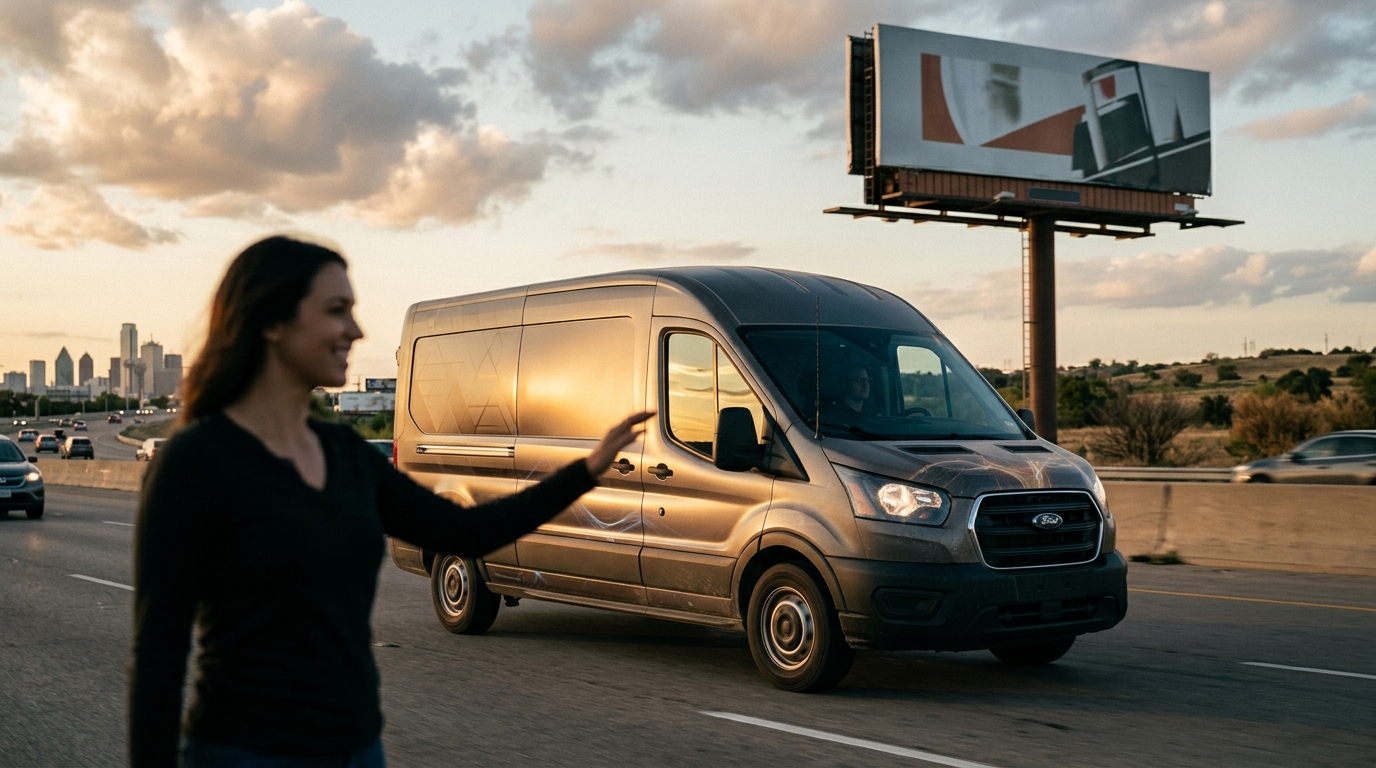
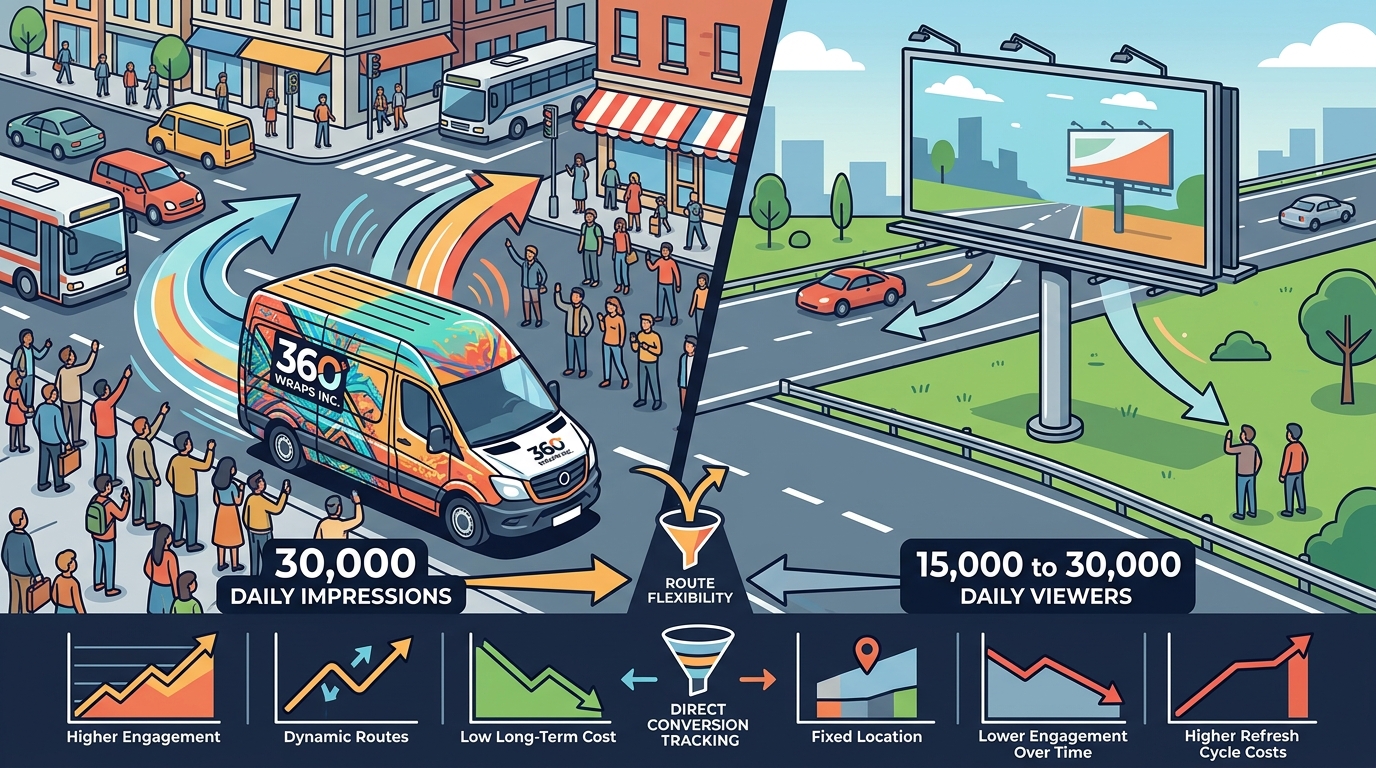
Modern fleet operators consistently report that mobile advertising generates roughly 30,000 daily impressions per vehicle, according to industry data. Traditional static billboards typically capture between 15,000 and 30,000 daily viewers, according to market reports. This comparison reveals a critical divergence in audience engagement, geographic flexibility, and long-term cost distribution. Businesses must evaluate how each medium performs across route density, creative refresh cycles, and direct conversion tracking. The financial outcome depends entirely on how you allocate capital across mobile versus stationary platforms.
Understanding Mobile Advertising Impressions
Mobile advertising impressions represent the total number of times a wrapped vehicle passes within visual range of potential customers, according to advertising studies. A single commercial van covering fifty miles daily accumulates roughly 15,000 to 30,000 daily impressions, according to traffic analyses. Static billboards rely on fixed highway or urban intersections, which limits audience diversity. Mobile platforms naturally penetrate residential neighborhoods, commercial districts, and industrial parks. This geographic distribution dramatically increases brand exposure across multiple demographic segments. Companies that deploy fifty wrapped vehicles effectively operate fifty independent billboards that never stop moving.
Calculating Cost Per Thousand Impressions
Cost per thousand impressions measures the exact financial efficiency of any advertising campaign, according to financial benchmarks. A standard full vehicle wrap typically costs between $3,000 and $6,000, according to pricing surveys. The same budget secures roughly two to three months of billboard placement in major metropolitan markets, according to lease agreements. Vehicle wraps deliver continuous exposure over three to five years without recurring rental fees. Billboards require monthly payments that escalate rapidly during peak advertising seasons. The long-term financial advantage clearly favors mobile platforms for sustained brand visibility.
Geographic Targeting and Route Flexibility
Geographic targeting defines the ability to position advertising assets within specific demographic or commercial zones, according to logistics frameworks. Fleet operators can program delivery routes to pass directly through target customer neighborhoods, according to routing studies. Static billboards remain fixed to municipal infrastructure, which restricts campaign adjustments. Mobile platforms adapt instantly to seasonal demand, product launches, or regional promotions. Companies can reposition entire fleets within hours to maximize local market penetration. This operational agility eliminates the lengthy permitting processes required for stationary outdoor displays.
Creative Longevity and Material Durability
Creative longevity refers to the lifespan of printed graphics under continuous environmental exposure, according to material science data. Premium cast vinyl wraps withstand UV radiation, extreme temperatures, and automated car washes for three to five years, according to manufacturer specifications. Traditional billboard vinyl degrades rapidly under direct sunlight, requiring biannual replacements, according to maintenance logs. Vehicle wraps utilize advanced lamination techniques that preserve color vibrancy and print resolution. Fleet operators benefit from consistent brand presentation without recurring production expenses. The initial investment compounds into substantial long-term savings across entire vehicle fleets.
Measuring Direct Conversion Pathways
Direct conversion pathways track how mobile advertising drives measurable customer actions, according to analytics models. Modern fleet campaigns integrate unique QR codes, dedicated landing pages, and geo-fenced mobile triggers, according to tracking protocols. Static billboards rely on estimated audience counts rather than verified engagement metrics, according to measurement standards. Mobile platforms generate verifiable click-through rates, phone inquiries, and store visits. Companies can attribute revenue directly to specific vehicle deployments. This data-driven approach eliminates guesswork and optimizes future marketing allocations.
Comparative Analysis Summary
| Feature | Vehicle Wraps | Traditional Billboards |
|---|---|---|
| Average Lifespan | Three to five years | Biannual replacements |
| Monthly Recurring Cost | Zero after installation | $1,500 to $5,000 (Data and statistics) |
| Geographic Flexibility | Full route customization | Fixed municipal locations |
| Conversion Tracking | Verified digital triggers | Estimated audience counts |
| Design Time Charges | None included | Additional fees apply |
Key Takeaways
- Family-owned operations since 2007 demonstrate consistent market leadership in nationwide fleet branding. (Industry Trends Stats)
- Coast-to-coast consistency ensures brand colors and body placement remain accurate across all fifty states.
- Zero design time charges eliminate upfront creative expenses for new fleet deployments.
- Workplace graphics extend branding discipline from vehicles into conference rooms and lobbies.
- Seamless wrap technology prevents peeling, fading, or color mismatch during routine maintenance.
- Rebranding experts maintain historical performance data across thousands of completed vehicle projects.
- Nationwide fleet branding scales efficiently from single commercial vans to multi-hundred vehicle deployments.
Frequently Asked Questions
How many daily impressions does a single wrapped vehicle generate?
A standard commercial vehicle covering fifty miles daily accumulates roughly 15,000 to 30,000 daily impressions, according to traffic studies. This volume consistently outperforms stationary outdoor displays in dense urban corridors.
Do vehicle wraps require recurring monthly payments?
Full vehicle wraps operate as one-time capital expenditures, according to financial models. Companies avoid monthly lease fees, permitting renewals, or municipal compliance charges.
Can mobile advertising be tracked like digital campaigns?
Modern fleet campaigns integrate unique QR codes, dedicated landing pages, and geo-fenced mobile triggers, according to analytics frameworks. This capability transforms passive visibility into measurable customer actions.
What happens when a fleet needs to update its branding?
Rebranding experts handle complete graphic refreshes without charging additional design time, according to service agreements. Companies can pivot messaging instantly while preserving existing vehicle infrastructure.
Are vehicle wraps suitable for extreme weather conditions?
Premium cast vinyl wraps withstand UV radiation, extreme temperatures, and automated car washes for three to five years, according to manufacturer specifications. This durability ensures consistent brand presentation across all seasonal cycles.
How does mobile advertising impact local community engagement?
Mobile platforms naturally penetrate residential neighborhoods, commercial districts, and industrial parks, according to routing analyses. This geographic distribution dramatically increases brand exposure across multiple demographic segments.
Can businesses combine vehicle wraps with indoor branding?
Workplace graphics extend branding discipline from vehicles into conference rooms and lobbies, according to integration guides. Companies maintain identical visual standards across mobile and stationary environments.
Final Recommendation
Vehicle wraps consistently deliver superior long-term returns compared to traditional billboards. The combination of extended lifespan, zero recurring costs, route flexibility, and verifiable conversion tracking creates a highly efficient marketing asset. Companies seeking coast-to-coast consistency and seamless wrap technology should evaluate their fleet deployment strategy immediately. Visit quote to request a custom proposal. Our team handles design, printing, and professional installation across all fifty states. Transform your fleet into a high-performance advertising platform today.