
Your company vehicles are already on the road every day. With the right strategy, every mile driven becomes a marketing impression—no recurring ad spend required. This guide breaks down exactly how to turn your fleet into a high-ROI advertising channel, from wrap design and route planning to tracking results.
Why Fleet Vehicle Advertising Outperforms Traditional Media
Fleet vehicle wraps are a form of out-of-home (OOH) advertising that converts ordinary work trucks, vans, and cars into mobile billboards. Unlike digital ads that can be blocked or skipped, a branded vehicle commands attention in the real world—at stoplights, in parking lots, and on highways.
The numbers make a compelling case. A single wrapped vehicle generates between 30,000 and 70,000 daily impressions depending on traffic and location, according to the Outdoor Advertising Association of America (OAAA). Over a full year, that translates to millions of brand views per vehicle. And because fleet wraps are a one-time investment rather than a recurring expense, the cost per impression drops dramatically over the wrap's lifespan.
Cost Per Thousand Impressions (CPM) Comparison
| Advertising Channel | Average CPM |
|---|---|
| Vehicle Wraps | $0.48–$0.77 |
| Billboards | $3.56 |
| Transit Ads | $7.45 |
| Newspaper | $19.70 |
Vehicle wraps deliver the lowest CPM of any major advertising format. According to OAAA data, the cost-per-thousand impressions for vehicle wraps can be as low as $0.77, while billboards average $3.56, transit ads $7.45, and newspaper advertising $19.70.
Fleet Wrap Advertising: The Statistics That Matter
- 30,000–70,000 daily impressions per wrapped vehicle in urban areas
- 97% recall rate for mobile wrap advertising, surpassing static ads
- 64% of survey respondents reported noticing vehicle graphics
- 44% of people notice a wrapped business vehicle every single week
- 15× more effective at creating name recognition than other advertising types
- OOH generates nearly 4× more online activations per ad dollar than TV, radio, and print
These statistics illustrate why fleet wraps consistently rank among the highest-ROI marketing investments available. Wrap advertising achieves a 97% recall rate, meaning the impressions are not just numerous—they stick.
Types of Fleet Vehicle Wraps: Full, Partial, and Decals
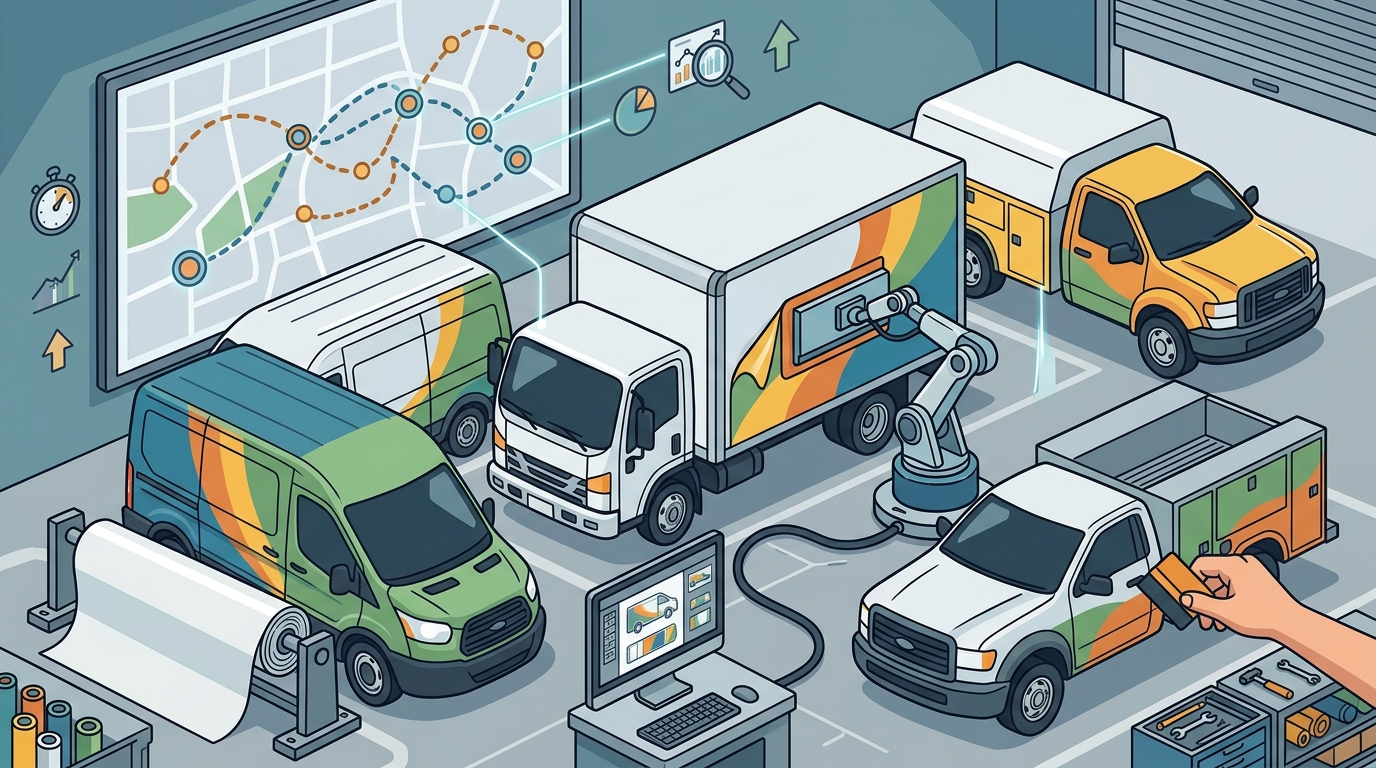
Not every fleet advertising strategy requires a full wrap. Understanding the options helps you match your budget to your visibility goals.
Full Wraps
A full wrap covers nearly every exterior surface of the vehicle, including windows with perforated film, delivering a seamless, high-impact visual. Full wraps are the most expensive option upfront but deliver the strongest brand recognition and also protect the vehicle's original paint from UV damage and road wear.
Partial Wraps
Partial wraps focus on specific high-visibility areas—typically the sides, hood, or rear panels. They incorporate the vehicle's original paint color into the design. While more budget-friendly, partial wraps can still make a strong impression when designed strategically.
Spot Graphics and Decals
Smaller vinyl elements such as a company logo, website address, or phone number applied to doors, tailgates, or rear windows. These are the most affordable entry point and work well for businesses testing fleet advertising before committing to full wraps.
Design Principles That Maximize Fleet Advertising Impact
A wrap is only as effective as its design. Bold visuals, bright colors, and clear messaging immediately catch the eye, even from drivers passing by at high speed. Here are the principles that separate high-performing fleet wraps from forgettable ones:
- Prioritize readability at speed. Your company name, phone number, and website must be legible from 50+ feet away. Use large, high-contrast fonts against a clean background.
- Limit your message. Drivers have seconds to absorb information. Focus on your brand name, one key service, and a single call to action. Avoid cluttering the design with multiple offers or paragraphs of text.
- Use bold colors and high contrast. Bright, saturated colors stand out in traffic. Dark text on a light background (or vice versa) ensures legibility in all lighting conditions.
- Include a clear call to action. Phrases like “Call for a free estimate” or “Book online at [website]” give viewers a reason to act and a clear next step.
- Maintain brand consistency across the fleet. Keeping branding consistent—logos, fonts, and colors—ensures people recognize your company wherever they see your vehicles. A uniform fleet creates a sense of scale and professionalism.
- Design for the vehicle's contours. Professional designers account for door handles, wheel wells, and panel seams. Key information should never fall on a crease or be obscured when a door opens.
Strategic Route Planning: Turning Miles into Marketing
Where your vehicles travel matters as much as how they look. Fleet wraps offer a highly effective form of localized, targeted advertising when routes are planned with marketing in mind.
Actionable Route Strategies
- Map high-traffic corridors. Prioritize routes through busy commercial zones, school drop-off areas, and commuter highways where dwell time at intersections increases exposure.
- Target your service area. A plumber's truck parked in a residential neighborhood reaches exactly the audience most likely to need plumbing services. No geographic targeting settings required—no wasted impressions on people hundreds of miles away.
- Rotate neighborhood coverage. Rotating coverage across neighborhoods creates a sense of omnipresence without extra costs, making your brand feel familiar and trustworthy to local consumers.
- Leverage parking as advertising. Every job site, grocery store parking lot, and residential street where your vehicle sits becomes a stationary billboard. Park in visible, high-foot-traffic locations whenever possible.
Industries That Benefit Most from Fleet Advertising
Fleet vehicle wraps are especially effective for businesses where local visibility and trust go hand in hand. Key industries include:
- Home Services (HVAC, Plumbing, Electrical, Lawn Care): Service vans drive right into customers' neighborhoods and become instant brand ambassadors. One HVAC company reported going from zero leads to numerous qualified inquiries per month after implementing fleet graphics.
- Delivery and Logistics: Branded delivery vehicles reinforce professionalism and brand memory every time they pull into a driveway. A regional delivery company observed a 33% increase in new customer inquiries over three months after branding its trucks.
- Food Service and Catering: Trucks and vans used for deliveries or events act as appetite-inducing, memorable mobile advertisements.
- Real Estate: Agents traveling between listings can advertise open houses and contact information with every mile driven.
- Healthcare and Mobile Clinics: Professional graphics make patients feel confident and more likely to remember your practice.
How to Track and Measure Fleet Advertising ROI
Unlike many traditional advertising channels, fleet wrap performance can be measured with the right systems in place. Implement these tracking mechanisms to quantify your investment:
Dedicated Phone Numbers
Assign a unique phone number to your fleet wraps that differs from your main business line. Every call to that number is a direct lead from vehicle exposure.
Custom Landing Pages and QR Codes
Print a short, memorable URL or QR code on your wrap that directs to a dedicated landing page. This lets you track web visits generated specifically by fleet exposure. QR codes and NFC tags bridge physical advertising with digital engagement.
Ask “How Did You Hear About Us?”
Train your intake team to ask every new customer how they found your business. Track “saw your truck/van” responses over time to build a dataset of wrap-attributed leads.
Simple ROI Calculation
Here is a straightforward framework: assume a $4,000 full wrap on a work truck with a 5-year lifespan. That works out to roughly $67 per month. Even if your wrap generates just one new customer per month worth $200–$500 in revenue, the wrap pays for itself many times over.
Maintaining Your Fleet Wraps for Maximum Longevity
A professionally installed wrap can last 3 to 7 years with proper care, providing ongoing promotion without recurring ad spend. Follow these maintenance practices:
- Wash regularly. A dirty wrapped vehicle sends the wrong message. Hand washing or touchless car washes keep your mobile billboard looking professional.
- Avoid harsh chemicals. Use mild, non-abrasive soap. Avoid pressure washers aimed directly at wrap edges.
- Park in shade when possible. Extended sun exposure accelerates vinyl degradation. Garage parking or shaded spots extend wrap life.
- Inspect quarterly. Check edges and seams for lifting. Catching small issues early prevents costly repairs or premature replacement.
- Budget for refresh cycles. Plan to update or replace wraps every 3–5 years to keep your brand image current and the vinyl in peak condition.
Choosing the Right Fleet Wrap Partner
The quality of your installation directly impacts how long your wraps last and how professional they look. Here is what to look for in a fleet wrap provider:
- Certified installers. Look for 3M or Avery Dennison certified professionals. Certification ensures proper technique and material handling.
- Nationwide capability. If you operate vehicles across multiple states, you need a partner with a national installer network that can maintain brand consistency from the first truck to the thousandth. 360 Wraps, for example, operates a network of over 3,000 certified installers across all 50 states, with a system developed over nearly two decades to keep brand colors and body placement accurate on every vehicle.
- In-house design. Partners that handle design, production, and installation under one roof reduce handoff errors and streamline timelines.
- Portfolio and references. Review past fleet projects and ask for references from businesses with similar fleet sizes.
- Written warranty. A reputable installer should offer a written warranty covering materials and workmanship.
Key Takeaways
- Fleet vehicle wraps are the most cost-effective advertising medium available, with CPMs as low as $0.48 compared to $3.56 for billboards and $19.70 for newspapers.
- A single wrapped vehicle generates 30,000–70,000 daily impressions—millions per year—with no recurring costs.
- Wrap advertising achieves a 97% recall rate and creates name recognition 15 times more effectively than other ad types.
- Design for speed: bold colors, large fonts, one clear call to action, and consistent branding across every vehicle in the fleet.
- Strategic route planning and parking in high-visibility areas amplify impressions without additional investment.
- Track ROI using dedicated phone numbers, custom URLs, QR codes, and customer intake questions.
- Choose a certified, nationwide installer like 360 Wraps to ensure quality, consistency, and long-term durability.
Frequently Asked Questions
How many impressions does a fleet vehicle wrap generate per day?
A single wrapped vehicle generates between 30,000 and 70,000 daily vehicular impressions in urban areas, according to OAAA and ARD Ventures research. Over a year, that can total millions of brand views per vehicle.
How much does a fleet vehicle wrap cost?
Full wraps typically range from $3,500 to $5,500 per vehicle depending on size and complexity. Professional design services add $500–$2,000. Partial wraps and spot graphics cost less and offer a budget-friendly entry point.
How long do fleet wraps last?
With proper care, professionally installed fleet wraps last 3 to 7 years. Premium cast vinyl from manufacturers like 3M and Avery Dennison offers the longest lifespan and best color retention.
Will a vehicle wrap damage my paint?
No. Quality vinyl wraps actually protect your vehicle's original paint from UV rays, minor scratches, and road debris. When removed by a professional, the underlying paint is preserved—an important benefit for leased vehicles.
Are fleet wraps better than digital advertising?
Fleet wraps and digital advertising serve complementary roles. Wraps excel at local brand awareness and trust-building with no recurring costs, while digital ads offer precise targeting and immediate click-through tracking. Research shows that including OOH in a larger media campaign increased the ROI for search by 40% and the ROI for print by 14%, making wraps a powerful amplifier for your digital efforts.
What industries benefit most from fleet vehicle advertising?
Home services (HVAC, plumbing, electrical), delivery and logistics, food service, real estate, and healthcare see the strongest returns. Any business with vehicles regularly traveling through its target market can benefit.
How do I measure the ROI of fleet wraps?
Use dedicated tracking phone numbers, custom landing page URLs, QR codes on the wrap, and “how did you hear about us” intake questions. Compare wrap-attributed leads and revenue against the one-time installation cost spread over the wrap's lifespan.