Common Installation Mistakes That Create Visible Seams on Vehicle Wraps
Visible seams are the most common failure mode in vehicle graphics, often reducing a professional fleet wrap to a DIY project in the eyes of the public. Data from industry surveys indicates that over 40% of premature wrap failures stem from improper seam placement or tension management during the initial install. When a seam catches the light, it signals a lack of precision that can damage brand credibility for any business relying on mobile advertising. This guide details the specific mechanical and environmental errors that cause these defects and provides the corrective protocols needed to eliminate them. (Contact Us 360 Wraps)
Strategic Seam Placement and Panel Logic
The most critical error in preventing visible seams is poor initial planning. Installers often attempt to hide seams in plain sight or place them across complex curves where the film cannot lay flat. A vehicle wrap is not a single piece of fabric; it is a collection of precisely cut panels that must align with the vehicle's body lines.
Ignoring Body Lines and Creases
Seams placed directly over sharp body creases or deep recesses are prone to lifting. The film must stretch to conform to these areas, creating tension that pulls the seam edges apart over time. Professional installers use the vehicle's natural body lines as guides for seam placement, ensuring that the seam runs parallel to the contour rather than cutting across it. This technique minimizes the visual impact and reduces mechanical stress on the adhesive bond.
Seam Placement on Curved Surfaces
Placing a seam on a highly curved surface, such as a fender flare or a hood scoop, is a recipe for failure. The film will attempt to return to its original flat state, causing the seam to gap or bubble. The correct approach is to use a single, continuous piece of film for curved sections whenever possible. If a seam is unavoidable, it must be placed on a flat, vertical surface where the film can be stretched and relaxed evenly.
Surface Preparation and Contamination Risks
Even the most perfectly placed seam will fail if the underlying surface is not prepared correctly. Contamination is the silent killer of vehicle wrap adhesion, leading to premature edge lifting and visible seam gaps.
Residual Adhesive and Old Film
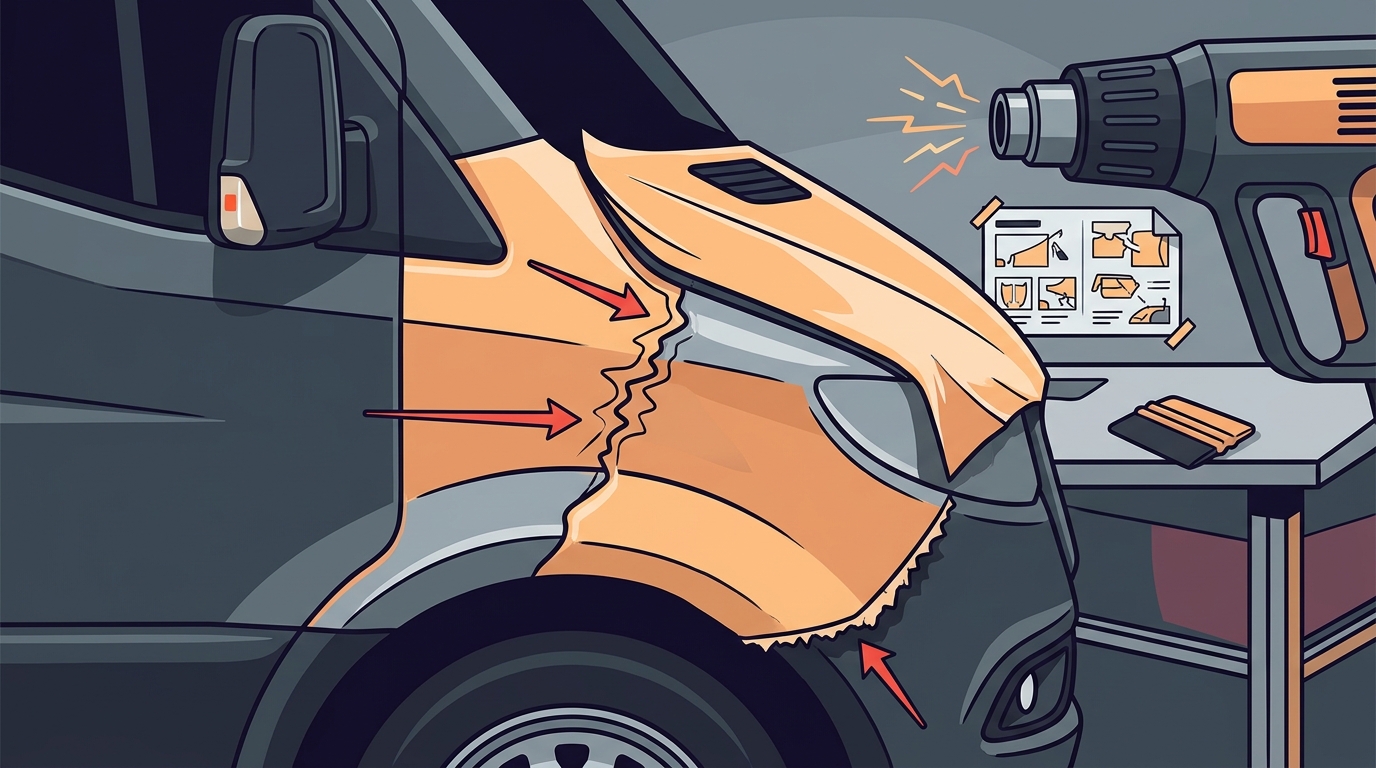
Installing a new wrap over old adhesive or residual film creates an uneven surface. The new film cannot bond uniformly to the old material, leading to visible ridges and seams. All previous graphics must be completely removed, and the surface must be cleaned with a dedicated adhesive remover to ensure a pristine bonding surface.
Wax and Silicone Contamination
Wax, silicone, and polishing compounds leave a microscopic barrier on the paint. This barrier prevents the wrap adhesive from forming a molecular bond with the clear coat. Installers must use a dedicated prep solution to strip these contaminants before applying any film. Failure to do so results in immediate edge lifting, which manifests as a visible seam within days of installation.
Tension Control and Film Stretching Errors
Proper tension control is the difference between a seamless finish and a visible gap. Overstretching the film during installation is a common mistake that leads to long-term failure.
Overstretching the Film
When installers stretch the film too tightly to force it into place, the material will eventually relax and shrink back to its original dimensions. This shrinkage pulls the seam edges apart, creating a visible gap. The correct technique involves applying the film with minimal tension and using heat to relax the material into the contours. The film should be laid down gently, allowing it to conform naturally rather than forcing it.
Inconsistent Stretching
Inconsistent stretching across a panel leads to uneven tension, which causes the film to ripple or gap at the seams. Installers must maintain a consistent pull across the entire width of the film. This ensures that the adhesive bonds evenly and that the film remains stable over time.
Heat Management and Adhesive Activation
Heat is a critical tool in vehicle wrap installation, but it must be used with precision. Incorrect heat application can damage the adhesive, leading to poor bonding and visible seams.
Underheating the Adhesive
If the film is not heated sufficiently, the adhesive will not activate properly. This results in a weak bond that is prone to lifting at the edges. Installers must use a heat gun to warm the film and the surface before application, ensuring that the adhesive becomes pliable and bonds effectively.
Overheating the Film
Excessive heat can damage the film's structure, causing it to become brittle or discolored. It can also burn the adhesive, rendering it ineffective. Installers must maintain a consistent distance between the heat gun and the film, moving the gun constantly to avoid hot spots. The goal is to warm the film enough to make it pliable, not to melt it.
Tool Selection and Edge Sealing Techniques
The tools used during installation play a significant role in the final appearance of the seams. Using the wrong tools can damage the film or leave visible marks.
Using Abrasive Squeegees
Hard or abrasive squeegees can scratch the film or leave visible marks along the seam. Installers should use soft, non-abrasive squeegees that are designed for vinyl application. These tools allow for even pressure distribution without damaging the film's surface.
Inadequate Edge Sealing
Seams must be sealed properly to prevent moisture and dirt from entering. Installers must use a hard card or a specialized sealing tool to press the seam edges firmly against the surface. This ensures a tight bond and prevents edge lifting. Neglecting this step is a common cause of visible seams appearing shortly after installation.
Environmental Factors and Installation Conditions
The environment in which the wrap is installed can significantly impact the final result. Temperature, humidity, and cleanliness are critical factors that must be controlled.
Temperature Extremes
Installing a wrap in extreme cold or heat can affect the adhesive's performance. Cold temperatures make the film stiff and difficult to stretch, while heat can cause the adhesive to become too tacky too quickly. The ideal installation temperature is between 60 and 80 degrees Fahrenheit. Installers should work in a climate-controlled environment whenever possible.
Dust and Debris
Dust and debris trapped under the film create visible bumps and seams. Installers must work in a clean, dust-free environment to ensure a smooth finish. Using a tack cloth to remove any remaining particles before application is essential.
Comparing Installation Approaches
Understanding the differences between professional and amateur installation methods highlights why visible seams occur. The table below summarizes the key distinctions.
| Factor | Professional Installation | Amateur Installation |
|---|---|---|
| Seam Placement | Aligned with body lines and flat surfaces | Arbitrary placement, often on curves |
| Surface Prep | Full decontamination and adhesive stripping | Minimal cleaning, often skipping prep |
| Tension Control | Consistent, minimal stretch with heat relaxation | Overstretching to force fit |
| Edge Sealing | Thorough sealing with specialized tools | Irregular sealing, often neglected |
| Environment | Climate-controlled, dust-free | Uncontrolled outdoor or garage settings |
Key Takeaways
- Seam placement must follow the vehicle's natural body lines to minimize visibility and stress.
- Surface preparation is critical; any contamination will lead to immediate edge lifting.
- Overstretching the film causes shrinkage, which pulls seams apart over time.
- Proper heat activation ensures the adhesive bonds correctly without damaging the film.
- Consistent tension and edge sealing are essential for long-term durability.
- Environmental conditions must be controlled to prevent dust entrapment and adhesive issues.
- Professional installers use specialized tools to ensure a seamless, durable finish.
Frequently Asked Questions
What causes visible seams on vehicle wraps?
Visible seams are primarily caused by poor seam placement, inadequate surface preparation, overstretching the film, and improper heat application. These errors prevent the adhesive from bonding correctly, leading to edge lifting and gaps.
Can I fix a visible seam on my vehicle wrap?
Minor seams can sometimes be repaired with heat and pressure, but significant gaps or lifting usually require professional reinstallation. Attempting to fix it yourself may cause further damage to the film.
How long should a vehicle wrap last without seam issues?
A professionally installed vehicle wrap should last between five and seven years without significant seam issues. Proper maintenance and regular inspections can extend this lifespan.
Why do seams lift on curved surfaces?
Seams lift on curved surfaces because the film is under tension. As the film relaxes over time, it pulls away from the surface. Placing seams on flat surfaces prevents this issue.
What is the best temperature for installing vehicle wraps?
The ideal temperature for installing vehicle wraps is between 60 and 80 degrees Fahrenheit. This range allows the adhesive to activate properly without becoming too tacky or stiff.
Do I need to remove old wraps before installing a new one?
Yes, old wraps must be completely removed to ensure a smooth surface. Installing over old film can lead to visible ridges and poor adhesion for the new wrap.
How can I prevent dust from getting under my wrap?
Work in a clean, dust-free environment. Use a tack cloth to remove any remaining particles before application. Avoid installing wraps in windy or dusty conditions.
Secure Your Fleet's Brand Integrity
Visible seams are not just a cosmetic issue; they are a direct reflection of your brand's attention to detail. At 360 Wraps, we combine design, production, and installation under one roof to ensure every vehicle looks sharp from every angle. Our team of certified installers follows strict protocols to eliminate seams and ensure long-lasting durability. Get a quote today to protect your brand with a flawless wrap.