Where to Find Reliable Vehicle Wrap Services in Texas and the USA
Reliable vehicle wrap services in Texas and the USA are found by verifying installer certifications, checking for nationwide fleet consistency systems, and confirming transparent design and production processes. This guide covers how to evaluate installer credentials, understand the difference between local shops and national networks, and identify the operational standards that protect your brand investment. We focus on the specific metrics and workflows that separate professional-grade wraps from amateur installations.
Installer Certifications and Professional Standards
Installer certification is a formal verification that a technician has completed specific training in vinyl application, surface preparation, and heat management. While there is no single government-mandated license for vehicle wrapping in the United States, industry leaders establish their own rigorous certification programs to ensure quality control. When searching for a reliable service, you must look beyond a generic business license and ask for proof of technical proficiency.
Why Certification Matters for Longevity
Professional certification ensures that installers understand the physics of vinyl adhesion. Amateur installers often rely on trial and error, which leads to premature peeling, bubbling, or color fading. Certified technicians are trained to manage tension, use proper squeegee techniques, and prepare surfaces to eliminate contaminants that cause failure. This technical depth is the primary differentiator between a wrap that lasts five years and one that fails in six months.
Verifying the Installer Network
Large-scale providers often use a network of independent installers. You must verify that these partners are actively vetted and monitored. A reliable company will have a dedicated coordinator who reviews quality control photos and manages project flow. For example, 360 Wraps installer network requires partners to demonstrate proven commercial capabilities and maintain proper insurance. This level of oversight ensures that the standard of care remains consistent regardless of the geographic location of the install.
Nationwide Consistency and Fleet Management
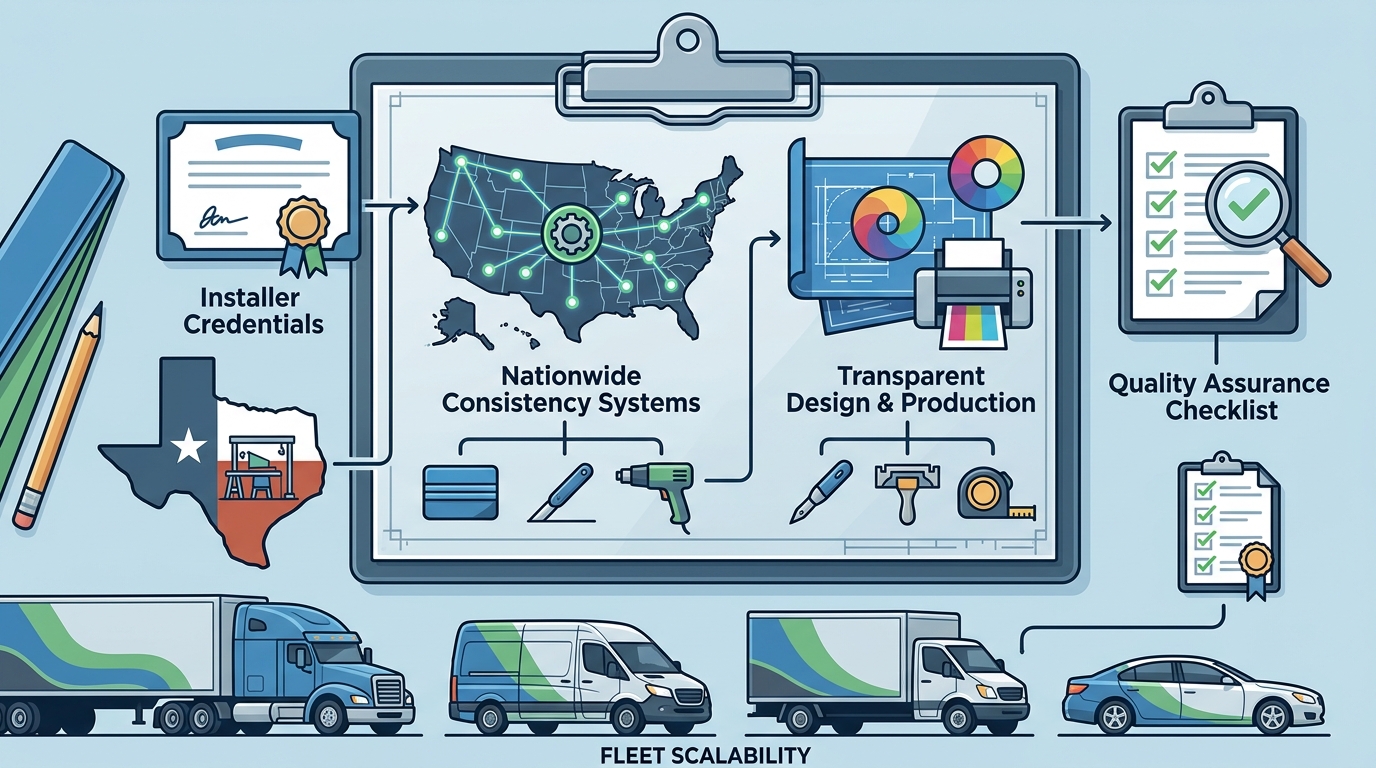
Nationwide consistency is the ability to maintain identical brand colors and body placement across a fleet of vehicles in multiple states. For businesses with operations in Texas and other regions, this is a critical operational requirement. Different printers and installers often interpret brand guidelines differently, leading to a fragmented visual identity. A reliable service provider must have a system to mitigate these variables.
The Challenge of Multi-State Fleets
Vehicle wraps are complex because every printer prints slightly differently, and vinyl formulations vary by manufacturer and state regulations. Without a centralized system, a vehicle in Houston may look different from a vehicle in Dallas. This inconsistency undermines brand trust. A robust fleet branding system accounts for these technical variances by standardizing color profiles and placement templates across all production facilities.
Coast-to-Coast Brand Management
Leading providers develop proprietary systems to manage this complexity. 360 Wraps nationwide fleet branding utilizes a system developed over a decade to ensure accurate colors and placement on every vehicle. This approach allows companies to scale from a single truck to a thousand vehicles across all 50 states without sacrificing visual integrity. The provider acts as a single point of contact, handling the logistics of production and installation across the country.
The Design and Production Workflow
The design and production workflow is the sequence of steps from initial consultation to final installation. A transparent workflow is a key indicator of reliability. Many small shops charge for design time separately, which can lead to budget overruns and misaligned expectations. A reliable service should offer a clear, documented process that keeps the client informed at every stage.
Consultation and Brand Alignment
The process begins with a deep dive into the client's brand identity and goals. The provider should ask about target audiences, competitive landscape, and specific messaging needs. This phase ensures that the final design is not just aesthetically pleasing but strategically effective. The provider should provide clear timelines and expectations during this stage to prevent scope creep.
Production and Quality Control
Production involves printing the vinyl using state-of-the-art technology. Reliable providers use premium materials and perform rigorous quality checks before shipping. They should provide digital proofs for approval and maintain a record of all design iterations. The production facility should be climate-controlled to ensure that the vinyl is stored and printed under optimal conditions, which affects adhesion and durability.
Material Quality and Warranty Considerations
Material quality is the physical specification of the vinyl used in the wrap, including its thickness, finish, and adhesive properties. The choice of material directly impacts the lifespan and appearance of the wrap. Reliable providers are transparent about the specific brands and grades of vinyl they use. They should be able to explain the differences between cast and calendered vinyl and how each affects the final result.
Understanding Vinyl Warranties
Vinyl warranties vary by manufacturer and state. Some warranties cover only color fade, while others cover peeling and bubbling. A reliable provider will help you understand the terms of the warranty and how to maintain it. They should also be able to provide documentation of the materials used, which is essential for claiming warranty coverage if issues arise. This transparency builds trust and ensures that you are protected against material defects.
Finish Options and Durability
Finish options include gloss, matte, satin, and chrome. Each finish has different maintenance requirements and durability profiles. For example, matte finishes are more prone to staining and require specific cleaning products. A reliable provider will advise you on the best finish for your vehicle's use case and environment. They should also provide care instructions to help you maintain the wrap's appearance over time.
Local Shops vs. National Networks
Choosing between a local shop and a national network depends on your specific needs and fleet size. Local shops may offer more personalized service and lower overhead, but they often lack the systems for large-scale consistency. National networks provide standardized processes and broader coverage, but they may have higher minimums. The table below summarizes the key differences to help you make an informed decision.
| Feature | Local Independent Shop | National Network Provider |
|---|---|---|
| Geographic Coverage | Single city or region | All 50 states |
| Brand Consistency | Dependent on individual installer skill | Systematized color and placement management |
| Design Support | Often charged separately | Included in qualifying fleet programs |
| Project Management | Direct communication with owner | Dedicated coordinator and QC team |
| Scalability | Limited by local capacity | High capacity with nationwide installer base |
For businesses with a single vehicle in Texas, a local shop may be sufficient. However, for fleets operating across multiple states, a national network like 360 Wraps offers the infrastructure needed to maintain brand integrity. The provider's ability to coordinate across multiple facilities and installer partners is a key advantage for complex projects.
Key Takeaways
- Verify installer certifications to ensure technical proficiency in vinyl application and surface preparation.
- Nationwide consistency requires a systematized approach to color management and body placement across states.
- Transparent design and production workflows prevent budget overruns and misaligned expectations.
- Material quality and warranty terms should be clearly documented and explained by the provider.
- National networks offer scalability and standardized quality control for multi-state fleets.
- Local shops may be suitable for single vehicles but often lack the infrastructure for large-scale consistency.
- Look for providers with a dedicated coordinator and quality control team to manage project flow.
- Climate-controlled production facilities ensure optimal vinyl storage and printing conditions.
Frequently Asked Questions
What is the most important certification for a vehicle wrap installer?
There is no single government-mandated certification, but industry leaders use their own programs to verify technical proficiency in vinyl application, heat management, and surface preparation. Look for providers who can demonstrate a rigorous vetting process for their installer network.
How do I ensure brand consistency across a multi-state fleet?
Use a provider with a systematized approach to color management and body placement. This involves standardizing color profiles and placement templates across all production facilities to mitigate printer and installer variances.
Do I need to pay for design time separately?
It depends on the provider. Many national networks include design exploration in qualifying fleet programs, while local shops often charge for design time separately. Clarify this during the initial consultation to avoid budget surprises.
What is the difference between cast and calendered vinyl?
Cast vinyl is more durable and conforms better to complex curves, making it ideal for full wraps. Calendered vinyl is less expensive and suitable for flat surfaces or partial wraps. A reliable provider will advise you on the best option for your specific vehicle and use case.
How long does a professional vehicle wrap last?
A professional wrap installed with high-quality materials typically lasts five to seven years. The lifespan depends on the material grade, installation quality, and maintenance practices. Proper care and regular cleaning can extend the life of the wrap.
Can I find a reliable wrap service in Texas?
Yes, Texas has a robust market for vehicle wrapping. Look for providers with a strong presence in the Dallas/Fort Worth area and a nationwide network for consistency. 360 Wraps is based in DFW and serves clients across the state and the country.
What should I ask a provider about their quality control process?
Ask how they review installations, what documentation they provide, and how they handle defects. A reliable provider will have a dedicated QC team that reviews photos and manages project flow to ensure consistent results.
Is it better to use a national network or a local shop for a single vehicle?
For a single vehicle, a local shop may be sufficient if they have strong reviews and certifications. However, a national network can offer higher standards of care and access to premium materials. Consider your specific needs and budget when making this decision.
Conclusion
Finding a reliable vehicle wrap service in Texas and the USA requires a focus on installer certifications, nationwide consistency systems, and transparent workflows. By verifying technical proficiency and operational standards, you can protect your brand investment and ensure a high-quality result. 360 Wraps offers a comprehensive approach to vehicle branding, combining premium materials with a systematized process for coast-to-coast consistency. To start your project, request a quote and discuss your specific needs with their team.